
September 2025
In an article published by Carnegie Europe in September 2025, Oana Popescu-Zamfir examines Moldova’s parliamentary elections as a decisive moment for the country’s European future. As Moldova prepares to launch its first accession negotiations with the European Union, the election also serves as a test of resilience against Russian attempts at interference aimed at slowing down, or even reversing, the process of European integration.
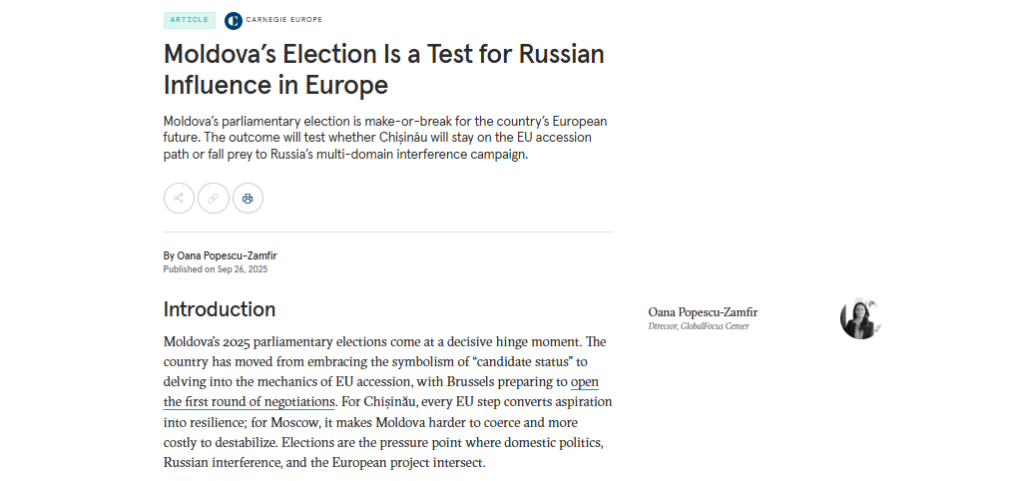
Moldova has become a prime target for the Kremlin’s influence strategies. Disinformation, covert funding of political networks, manipulation of social media, and the exploitation of identity, religious, and energy issues: these various tactics are part of a broader campaign aimed at undermining democratic institutions, weakening public support for the European Union, and keeping the country in a state of geopolitical uncertainty. The goal is not necessarily to secure an openly pro-Russian electoral outcome, but rather to delay reforms, divide pro-European forces, and make the accession process more vulnerable to political deadlocks.
The stakes extend far beyond Moldova’s borders. A setback for Moldova on its path toward the EU would weaken the European Union’s position in the Black Sea region, reduce Ukraine’s strategic depth and undermine the legitimacy of the enlargement policy. By contrast, holding reliable elections and continuing reforms could demonstrate that a small state facing constant external pressure is capable of strengthening its democratic resilience and pursuing its European integration.
You can read the article “Moldova’s Election Is a Test for Russian Influence in Europe” by Oana Popescu-Zamfir, published by Carnegie Europe in September 2025, here.


