14 October 2026
“Though obstacles remain, Podgorica’s ambition to join EU in 2028 is achievable” writes Dimitar Bechev of Canergie Europe in his substack “Scramble for Europe” after a study visit to Montenegro. The visit was partially supported by the Open Society Institute – Sofia through the Think Tanks for the Future of EU Enlargement Program (TFEP). The trip was organized by DGAP in Berlin, Carnegie Europe, Jacques Delors Institute in Paris, and the Clingendael Institute in The Hague, and was implemented with the cooperation of the Institute for Sociopolitical Research – Analitico in Podgorica.
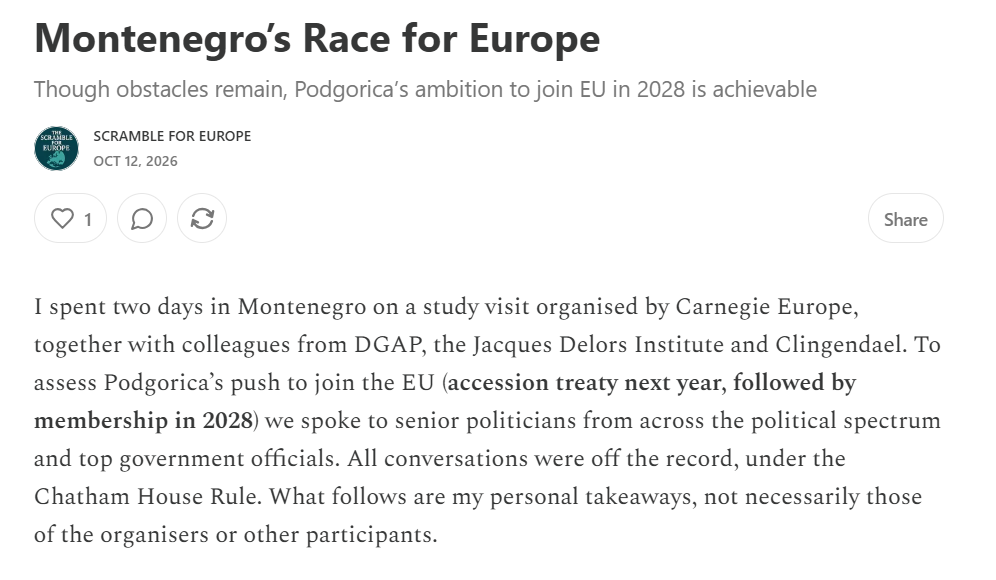
Montenegro has positioned itself as a frontrunner in the Western Balkans’ latest push for EU enlargement, setting an ambitious target to sign an accession treaty by 2027 and formally join the bloc as its 28th member by 2028. Following a recent surge in closing negotiating chapters, Podgorica’s objective is increasingly seen as technically feasible. However, as insights gathered from high-level institutional and political discussions in Podgorica reveal, navigating the final stretch of reforms will require overcoming substantial domestic hurdles.
A critical variable in this race is Montenegro’s internal political landscape, particularly the stability of Prime Minister Milojko Spajić’s governing coalition and its delicate partnership with key political figures such as Serb leader Andrija Mandić. With upcoming electoral tests on the horizon, domestic polarization and competing geopolitical alignments threaten to derail reform efforts. Ensuring consistent institutional progress requires leadership capable of keeping a fractured political spectrum unified behind the European integration agenda.
Ultimately, the stakes of Montenegro’s accession extend far beyond its borders, acting as a crucial litmus test for the credibility of the EU’s enlargement policy. A prolonged delay or failure to deliver would validate cynical narratives—such as those advanced by external actors and regional spoilers—that the EU continually shifts the goalposts, inadvertently handing a strategic victory to Russia. Consequently, successfully bringing Montenegro across the finish line represents a vital strategic imperative for a cohesive and secure Europe.
You can read Dimitar Bechev’s full analysis here