7 October 2026
Carnegie Europe
The coming weeks will be crucial in determining whether the European Union can reform its sluggish accession mechanics and set itself on a credible enlargement path. As geopolitical shifts and external vulnerabilities reshape the continent’s architecture, Brussels faces a time-sensitive imperative to advance its integration agenda and re-energize the accession process.
In the latest Strategic Europe commentary, Dimitar Bechev of Carnegie Europe sketches out what is and what is not on the EU’s evolving enlargement agenda, examining the high stakes involved in this pivotal period. Read the full piece to gain sharp insights into how step-by-step single market integration could alter the future shape of Europe and the critical choices facing policymakers.
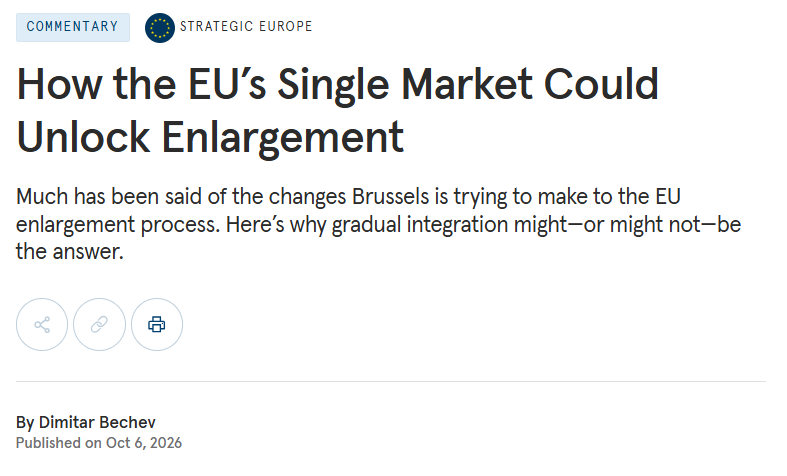
Part of the ongoing debate surrounding the bloc’s expansion, this analysis unpacks the complex web of candidate countries—ranging from Western Balkan hopefuls to Eastern European frontrunners—and evaluates what is realistically achievable on the economic and regulatory horizon. It addresses the legal complexities, judicial oversight questions, and stringent compliance conditions the union must uphold if gradual integration is to succeed without lowering standards.
The piece also tackles the strategic realities of geoeconomics, noting how global protectionism, supply chain vulnerabilities, and hedging behaviors by nations like Serbia, Turkey, or Georgia complicate the picture. Navigating these diverging geopolitical alignments will be vital to keeping the enlargement momentum alive amidst competing priorities.
You can find the article “How the EU’s Single Market Could Unlock Enlargement” authored by Dimitar Bechev, a senior fellow at Carnegie Europe, published in Strategic Europe here.