
29 September 2026
DGAP
As Bosnia-Herzegovina heads toward high-stakes general elections amid a prolonged institutional crisis, the international architecture that has preserved its fragile postwar stability is fracturing. A major shift in U.S. foreign policy under the Trump administration—favoring transactional business interests over institutional oversight—has broken the long-standing Western consensus behind the Dayton Peace Agreement.
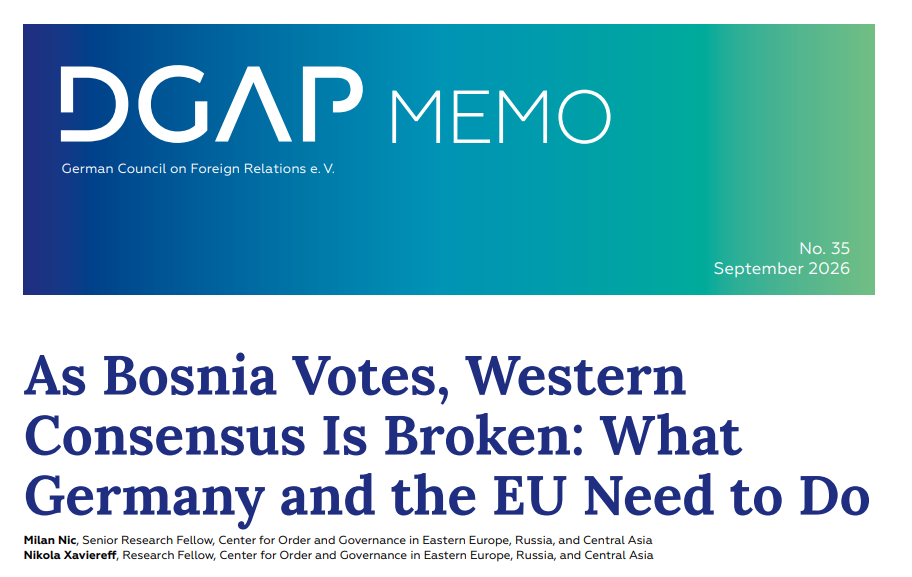
In the DGAP Memo “As Bosnia Votes, Western Consensus Is Broken: What Germany and the EU Need to Do,” researchers Milan Nič and Nikola Xaviereff of the German Council on Foreign Relations (DGAP) analyze how this geopolitical vacuum and a weak, disjointed international oversight leave the country vulnerable. They detail how Washington’s sudden pressure and shifting commercial priorities risk undermining the state’s functional institutions and its path toward European integration.
The analysis unpacks the complex post-election dynamics, warning that a victory for obstructive local leaders could trigger severe political stalemates and ethno-territorial maneuvers. With regional spillovers threatening European security and potentially offering Russia a low-cost option to divert Western resources, the authors stress that local political instability remains a critical challenge for the entire continent.
To navigate this dangerous transition, Nič and Xaviereff argue that Brussels and Berlin must step up to prevent a political vacuum, restore integration momentum, and develop a more unified European approach. Read the full memo As Bosnia Votes, Western Consensus Is Broken by Milan Nič and Nikola Xaviereff from the German Council on Foreign Relations to explore their full recommendations here


